Building Better Infrastructure at a Lower Total Cost
The infrastructure supporting our connected world continues to evolve. The expansion of 5G, small cells, mid-cell deployments, intelligent lighting, security systems and IoT technologies is creating demand for infrastructure that can be deployed faster, installed more efficiently and operated at a lower total cost.
For decades, steel, aluminum and wood have been the traditional materials used for poles and vertical infrastructure. While these materials continue to serve important applications, today’s wireless and smart-city deployments are creating new requirements.
Modern infrastructure must be lightweight, durable, corrosion resistant, easy to install and capable of supporting multiple technologies.
This is where EasyStreet Systems and FRP technology offer a compelling alternative.
At EasyStreet Systems, we believe a pole should be more than a structural component. It should be a cost-effective infrastructure platform designed to meet the evolving needs of Telecom, Lighting and IoT deployments.
Our goal is to help customers reduce installation costs, simplify deployment and achieve lower total lifecycle costs without compromising the structural requirements of their projects.
The Real Cost of a Pole Goes Beyond the Purchase Price
When evaluating infrastructure, it’s easy to focus on the initial purchase price of a pole. However, the actual cost of ownership extends well beyond the material itself.
The total project cost can include:
- Transportation
- Labor
- Equipment and mobilization
- Installation
- Maintenance
- Repairs and replacement
Transportation + Labor + Equipment + Installation + Maintenance + Replacement = Total Lifecycle Cost
This is where FRP can provide an economic advantage.
EasyStreet FRP poles are designed to be lightweight, durable and corrosion resistant. These characteristics can help customers reduce costs throughout the infrastructure lifecycle, not just at the time of purchase.
For contractors, wireless carriers, municipalities and infrastructure owners, the objective should be to minimize the total installed and lifecycle cost, rather than focusing solely on the initial material price.
Our objective isn’t simply to sell a lower-cost pole. It’s to help our customers build and operate lower-cost infrastructure.
Lightweight Construction Can Reduce Installation Costs
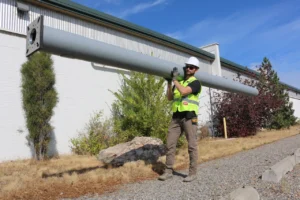
One of the most important advantages of FRP is its strength-to-weight ratio. Depending on the design, FRP poles can provide the structural performance required for many Telecom, Lighting and IoT applications while weighing significantly less than comparable structures.
That difference matters in the field.
A lighter pole can simplify:
- Transportation and delivery
- Material handling and staging
- Crew requirements
- Pole positioning and installation
- Equipment requirements
- Access to challenging installation sites
Depending on the application, lighter infrastructure may reduce the need for cranes and other heavy equipment. This can be particularly valuable in locations where access is restricted, equipment mobilization is expensive or minimizing disruption is a priority.
For contractors managing multiple installations, these advantages can translate into improved productivity and potential cost savings.
The value of lightweight FRP isn’t simply that the pole weighs less. It’s that a lighter structure can make the entire installation process more efficient.
Faster Installation Means Lower Installed Costs
Labor is one of the largest variables in infrastructure deployment. Every hour a crew spends transporting, handling, positioning and installing a pole contributes to the overall project cost.
EasyStreet FRP poles are designed to simplify handling and support efficient installation. For large-scale deployments involving hundreds or thousands of structures, even modest reductions in installation time can create meaningful project savings.
Potential advantages include:
- Reduced material handling
- Less equipment dependency
- More efficient crew utilization
- Shorter installation activities
- Reduced time spent at each site
Actual savings will depend on the pole design, site conditions, foundation requirements, equipment and installation methods. However, the opportunity to improve deployment efficiency can be significant.
Less handling. Less equipment. Less labor. Less time on site.
When multiplied across a large deployment, these efficiencies can have a greater financial impact than a reduction in the pole’s initial purchase price alone.
Lower Transportation and Equipment Costs
Traditional poles may require large trucks, cranes and specialized equipment, depending on their size, weight and installation location.
FRP’s lightweight construction creates opportunities to simplify transportation and handling. In appropriate applications, EasyStreet FRP poles may be easier to move, stage and install, potentially reducing transportation and equipment requirements.
Potential benefits include:
- Reduced transportation and delivery requirements
- Lower equipment mobilization costs
- Reduced reliance on cranes, where appropriate
- Improved crew efficiency
- Less disruption at the installation site
These advantages can be particularly valuable for:
- Small-cell deployments
- Mid-cell deployments
- Urban environments
- Residential neighborhoods
- Business districts and campuses
- Parking facilities
- Pedestrian areas
- Remote locations
- Smart-city applications
Whether the project involves wireless communications, lighting, security or IoT infrastructure, reducing installation complexity can contribute to lower total installed costs.
The right pole design can help customers optimize the entire deployment process, not just the structural component.
Corrosion Resistance Helps Reduce Lifecycle Costs
Infrastructure is expected to remain in service for many years, often decades. During that time, poles may be exposed to rain, moisture, salt air, chemicals, temperature changes and other environmental conditions.
Material selection plays an important role in long-term maintenance requirements.
Steel can be susceptible to corrosion when protective systems are damaged or compromised. Wood can be subject to rot and other forms of deterioration. FRP, by contrast, offers inherent resistance to many forms of corrosion and does not rust or rot like conventional steel and wood.
This can create an important long-term economic advantage.
For infrastructure owners, corrosion resistance may help reduce:
- Corrosion-related maintenance
- Repairs and recoating requirements
- Material deterioration
- Service interruptions associated with maintenance
- Premature replacement costs
Actual performance depends on the FRP formulation, manufacturing process, environmental exposure, loading and application requirements. Proper engineering and product selection remain essential.
For EasyStreet customers, the key consideration is not just how much a pole costs to purchase, but how much it costs to own and maintain throughout its service life.
The least expensive pole to purchase isn’t necessarily the least expensive pole to own.
EasyStreet’s Lifecycle Cost Advantage
By combining lightweight construction with corrosion-resistant FRP technology, EasyStreet Systems seeks to help customers evaluate infrastructure based on its total cost of ownership.
That includes the initial pole cost, installation expenses, transportation, equipment, maintenance and long-term operational considerations.
A lower lifecycle cost can improve the economics of infrastructure projects while helping owners plan for long-term performance.
EasyStreet FRP Poles Are a Natural Fit for Wireless Infrastructure
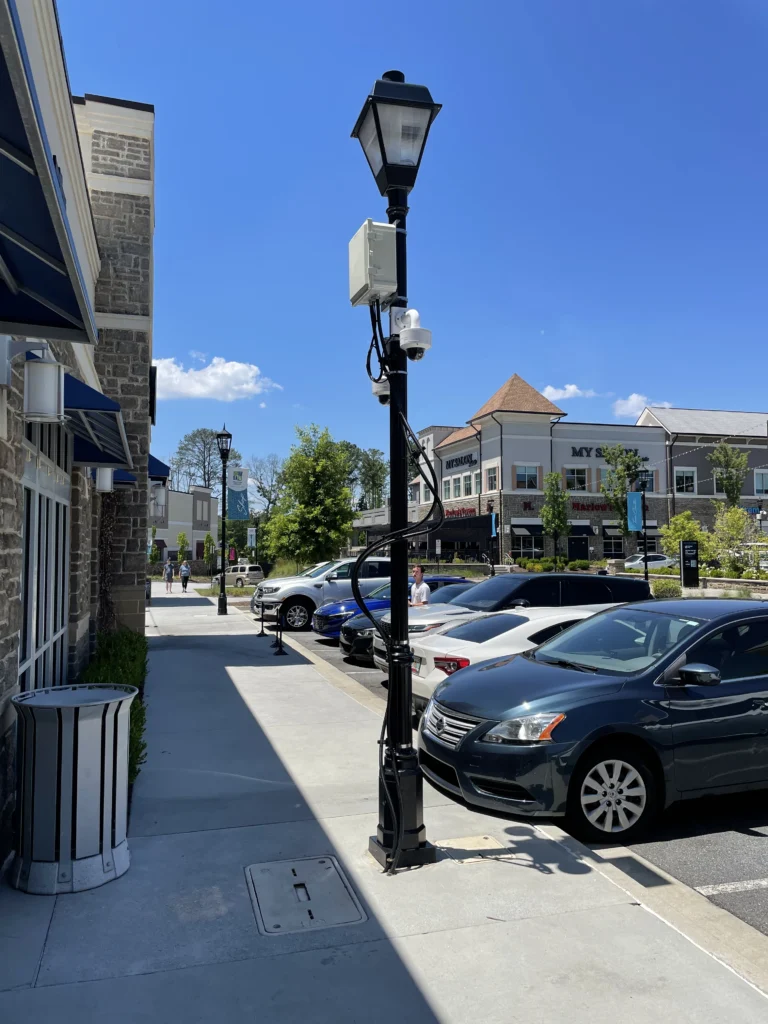
Wireless networks continue to densify as carriers deploy more small cells, mid cells, radios and other network equipment closer to customers.
These deployments are taking place in neighborhoods, business districts, campuses, transportation corridors, parking facilities and other locations where traditional infrastructure can be difficult or expensive to install.
The evolution of wireless technology is increasing the need for infrastructure that supports:
- Compact wireless equipment
- Antenna and radio mounting
- Small-cell and mid-cell deployments
- Multi-technology installations
- Efficient site construction
- Long-term durability
- Cost-effective expansion
EasyStreet FRP poles are designed to address the evolving requirements of modern wireless infrastructure.
Their lightweight construction can support more efficient handling and installation, while corrosion resistance can provide value in demanding outdoor environments.
For carriers, contractors and infrastructure owners, these characteristics can help create opportunities to reduce deployment costs and simplify the installation of wireless assets.
Supporting the Next Generation of Connected Infrastructure
At EasyStreet Systems, we understand that successful wireless deployments require more than a pole that meets structural specifications. They require solutions that account for installation logistics, site access, labor, maintenance and long-term operational costs.
With extensive experience in the telecommunications industry, EasyStreet focuses on the practical challenges associated with deploying infrastructure in real-world environments.
Our mission is to help customers build reliable, cost-effective infrastructure that supports the continued growth of wireless communications and connected technologies.